
Find informative posts written to help you stay informed and better understand the legal landscape, and more.
April 27, 2026
Why Does the Difference Between a Pinellas County Felony and Misdemeanor Matter for Your Future?
In Florida, the legal system classifies crimes into two primary categories: misdemeanors and felonies. While many people assume a misdemeanor is "just a ticket" or a "slap on the wrist," any criminal charge in Pinellas County carries significant weight. Florida criminal laws are notoriously strict, and the way your case is handled in the early stages can determine whether you maintain your career, your housing, and your right to bear arms.
The first step to building a good defense is to understand the differences between these two groups. If you are facing a first-time DUI or a complicated white-collar felony, it is very helpful to know how Pinellas County prosecutors handle these cases.
1) What Distinguish a Misdemeanor From a Felony in Florida?
Under Florida Statute 775.08, the primary distinction between a misdemeanor and a felony lies in the potential length and location of incarceration. A misdemeanor is defined as any criminal offense punishable by a term of imprisonment in a county jail not exceeding one year. Conversely, a felony is a more serious crime that carries the possibility of more than one year in a state prison or even the death penalty.
It is a common misconception that the "severity" of the act alone determines the charge. In reality, many offenses occupy a "wobbler" space where a prosecutor’s discretion can escalate a charge from a misdemeanor to a felony based on prior record or aggravating factors. For instance, a simple theft might be a misdemeanor, but if it involves a certain dollar amount or specific items, it quickly transforms into a felony grand theft.
2) How Do Misdemeanor Penalties Affect Your Life in St. Petersburg?
Misdemeanors in Pinellas County are handled in County Court. While they are less severe than felonies, they are still criminal offenses that appear on background checks. They are divided into two degrees:
Second-Degree Misdemeanor: These are the least serious criminal offenses, such as disorderly conduct or first-time petit theft. The maximum penalty is 60 days in county jail and a $500 fine.
First-Degree Misdemeanor: This category includes offenses like battery, possession of marijuana (under 20 grams), or a first-time DUI on a bike. A conviction can lead to up to one year in county jail and a $1,000 fine.
Even if you avoid jail time, a misdemeanor conviction can lead to a permanent criminal record. This is why many defense strategies focus on securing a "withhold of adjudication," which allows a defendant to complete probation without technically having a "conviction" on their record for certain purposes.
3) Why Are Felony Charges More Dangerous in the Sixth Judicial Circuit?
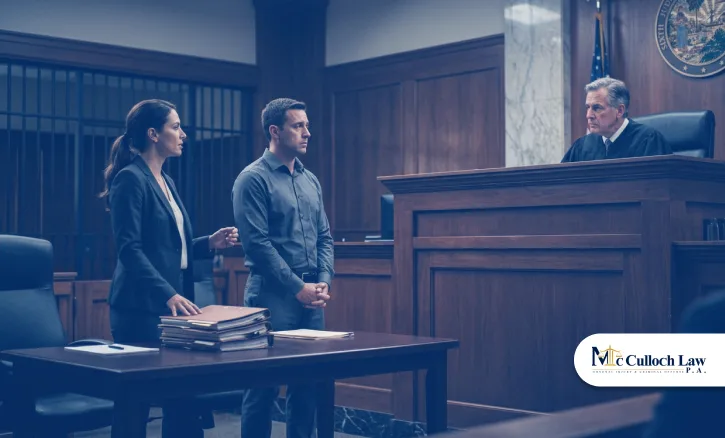
Felonies are high-stakes cases prosecuted in the Circuit Court. The Sixth Judicial Circuit, which serves Pinellas and Pasco counties, takes felony offenses very seriously. Unlike a misdemeanor, where you might be released on your own recognizance or a low bond, felony arrests often involve more stringent pretrial release conditions.
Florida classifies felonies into several degrees:
Third-Degree Felony: Punishable by up to five years in prison (e.g., possession of a controlled substance).
Second-Degree Felony: Punishable by up to 15 years in prison (e.g., aggravated battery).
First-Degree Felony: Punishable by up to 30 years in prison (e.g., armed robbery).
Life and Capital Felonies: Punishable by life in prison or the death penalty.
A felony conviction carries "collateral consequences" that a misdemeanor does not. You lose the right to vote, the right to serve on a jury, and the right to possess a firearm. Furthermore, a felony record makes it nearly impossible to obtain certain professional licenses in Florida. If you are facing such serious allegations, understanding what is a sex offense crime or other high-level felonies is critical to your defense.
4) Which Court Handle Your Criminal Case in Clearwater?
Location matters in the Florida legal system. If you are arrested in St. Petersburg, Clearwater, or Largo, your case will likely be heard at the Pinellas County Justice Center on Roosevelt Boulevard.
County Court: This is where misdemeanors, traffic infractions, and municipal ordinance violations are resolved. The atmosphere is often fast-paced, and cases frequently settle through plea bargains or diversion programs.
Circuit Court: This court handles all felony cases. The procedures here are more formal, the discovery process (the exchange of evidence) is more extensive, and the potential for a jury trial is much higher.
To get around these halls, you need a Clearwater criminal lawyer who knows the local judges and prosecutors. Each judge has their own "sentencing philosophy," and an experienced attorney knows how to tailor a plea or a trial strategy to the specific individual wearing the black robe.
5) Can a Felony Charge Reduce to a Misdemeanor?
One of the most powerful tools in a defense attorney’s arsenal is the ability to negotiate a "downward departure" or a charge reduction. Prosecutors often overcharge defendants in the initial arrest phase. A skilled attorney will examine the evidence to find "litigation risks" for the state—reasons why a jury might not convict on a felony charge.
Strategies for Reducing Charges Include:
Highlighting Evidentiary Weaknesses: If the police conducted an illegal search, a motion to suppress can eliminate the state's best evidence.
Demonstrating Lack of Intent: For crimes like burglary or fraud, proving a lack of criminal intent can drop a felony to a lesser misdemeanor.
Mitigation Packages: Showing a defendant's lack of prior record, employment status, and community ties can convince a prosecutor to "break down" the charge.
Pre-Trial Intervention (PTI): For certain non-violent third-degree felonies, we can often negotiate for a diversion program that results in a total dismissal of charges upon completion.
If your case involves domestic issues, understanding what is 3rd degree domestic violence can be helpful in seeing how specific statutes allow for charge negotiations.
6) What Are the Long-Term Consequences of a Criminal Conviction?

The damage of a criminal charge doesn't end when you leave the courtroom. In the digital age, your mugshot and case details are easily accessible to employers, landlords, and nosy neighbors.
Important Information Regarding Your Record:
Employment Barriers: Many corporations have a zero-tolerance policy for felony convictions. Even a misdemeanor battery or theft can disqualify you from jobs in healthcare, education, or finance.
Housing Difficulties: Landlords in Pinellas County frequently run background checks. A felony record can lead to an automatic denial of your rental application.
Loss of Civil Rights: As mentioned, felons in Florida lose the right to vote and own firearms. While there is a process for the restoration of civil rights, it is arduous and often takes years.
Public Perception: The social stigma of being a "convicted felon" can affect personal relationships and community standing.
This is why it is vital to know the steps to take right after an arrest. The decisions you make in the first 24 hours often dictate whether you can later apply for criminal record expungement or sealing.
7) How Does a Criminal Defense Attorney Build a Strategy for You?
Every case is unique, but the goal is always the same: to minimize the impact on your life. A comprehensive defense strategy starts with a deep dive into the police report and body camera footage. We look for procedural errors, such as a failure to read Miranda rights or a lack of probable cause for a traffic stop.
In cases involving property damage or vandalism, a Tampa criminal mischief attorney can often negotiate for restitution in exchange for a dismissal. By paying for the damages upfront, the state is often more willing to resolve the case without a formal conviction.
Furthermore, we utilize experts—from private investigators to forensic accountants—to challenge the state’s narrative. In the Sixth Judicial Circuit, the "burden of proof" lies entirely on the prosecutor. Our job is to create "reasonable doubt" at every turn.
8) Secure Your Future With McCulloch Law, P.A.

When you are facing the weight of the Florida legal system, you need more than just a lawyer; you need a dedicated advocate who understands the local landscape of Pinellas County. At McCulloch Law, P.A., we bring "insider insights" to every case we handle. Our firm is built on the foundation of aggressive representation and personalized service.
We understand that an arrest is one of the most stressful events in a person’s life. Whether you are dealing with injunctions in criminal law or a serious felony charge, we are here to provide the guidance you need. We pride ourselves on our accessibility and our commitment to protecting the rights of individuals in St. Petersburg, Clearwater, and throughout the Tampa Bay area.
Do not let a mistake or a false accusation define your future. Contact McCulloch Law, P.A. today for a consultation and let us start building your defense. Remember, the state has vast resources to prosecute you. For more information on our services, visit the Pinellas County Clerk of Court website.
Recent Blogs